
A couple I know fell in love with a flat on a weekend visit. The agent wrote an EMI figure on the back of a brochure, they nodded and the booking was almost made. On the way home, the husband opened a calculator on his phone and typed in the numbers himself. The EMI was nearly a fifth higher than the brochure's number, because the brochure had used a longer tenure and a lower rate than any bank was offering them. They didn't lose the flat, but they renegotiated, and they were very glad they had checked.
I used to think EMI calculations were something banks did, and my only job was to say yes or no. Every agent and every advertisement quoted a monthly figure, so I treated it as a fact. In reality, an EMI depends on three simple inputs, and you can calculate it yourself in a minute. If you've ever nodded at a monthly figure without knowing where it came from, you know exactly what I mean.
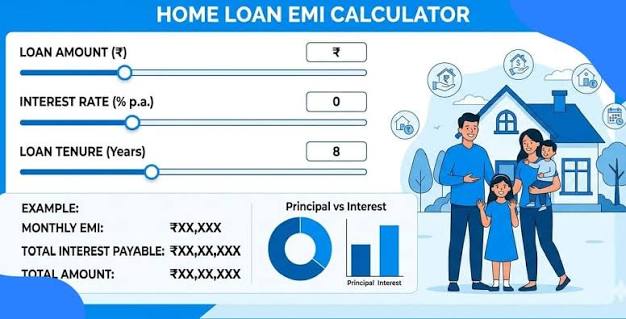
So this guide shows how to calculate your home loan EMI before buying a house, how different choices change the number and how to test whether you can really afford it. The figures here are illustrations, not current offers, so always plug in your own lender's rate. It's general information, not financial advice.
What an EMI Really Is

EMI stands for equated monthly instalment. It's the fixed amount you pay each month, and it covers both interest and a part of the principal. In the early years, most of each payment goes to interest. Over time, the interest share shrinks and the principal share grows. The total you pay over the life of the loan is always more than the amount you borrowed, and the gap depends mostly on the rate and the tenure.
The EMI is the same every month for a fixed-rate home loan
Early payments are mostly interest
Later payments are mostly principal
A longer tenure lowers the EMI but raises total interest
On a floating-rate loan, the EMI or tenure can change when rates change
The Three Inputs You Need
Every EMI calculation depends on just three numbers. Get these right, and the rest is simple.
Loan amount (P): the property price minus your down payment
Interest rate (R): the annual rate your lender offers, converted to a monthly rate
Tenure (N): the number of monthly payments, which is years multiplied by twelve
Don't forget to include any fees that are added to the loan, because they increase the amount you actually repay.
The EMI Formula, Without the Fear

🧮 1. Understand EMI
✓ Monthly payment
✓ Principal amount
✓ Interest charges
✓ Loan duration
✓ Monthly instalment
✓ Repayment planning
💡 Trick: Know your EMI basics.

🏠 2. Loan Amount
✓ Property price
✓ Down payment
✓ Required loan
✓ Bank offer
✓ Extra expenses
✓ Borrowing limit
💡 Trick: Borrow within budget.

📊 3. Interest Rate
✓ Annual rate
✓ Monthly rate
✓ Fixed option
✓ Floating option
✓ Bank comparison
✓ Rate changes
💡 Trick: Compare lender rates.

📅 4. Loan Tenure
✓ Repayment years
✓ Monthly EMI
✓ Longer tenure
✓ Shorter tenure
✓ Total interest
✓ Payment comfort
💡 Trick: Compare loan periods.

💻 5. EMI Formula
✓ P = Principal
✓ R = Monthly rate
✓ N = Total months
✓ Apply formula
✓ Calculate EMI
✓ Check result
💡 Trick: Use an EMI calculator.

💰 6. EMI Budget
✓ Monthly income
✓ Household costs
✓ Existing loans
✓ Savings amount
✓ Emergency fund
✓ Affordable EMI
💡 Trick: Keep EMI manageable.
The standard formula looks scary, but it's only arithmetic:
EMI = P × r × (1 + r)^n ÷ ((1 + r)^n − 1)
Here, r is the monthly rate (annual rate ÷ 12 ÷ 100) and n is the number of months. You almost never need to do this by hand. An online EMI calculator or a spreadsheet will do it instantly. In a spreadsheet, the function is typically PMT, entered as the monthly rate, the number of months and the loan amount as a negative number.
Convert the annual rate to a monthly rate before using the formula
Use months, not years, for the tenure
Use a spreadsheet or calculator to avoid mistakes
Check the result against your lender's own figure
Keep the inputs in a note, so you can change one at a time
A Worked Example
Let's say you borrow ₹50 lakh at an illustrative 8% a year for 20 years. The EMI comes to about ₹41,822 a month. Over 240 months, you'd repay roughly ₹1.0 crore in total, which means about ₹50.4 lakh is interest. In the very first month, around ₹33,333 of that EMI is interest and only about ₹8,489 reduces the loan. That's why the balance seems to drop slowly at first.
Loan: ₹50 lakh
Illustrative rate: 8% a year
Tenure: 20 years
EMI: about ₹41,822
Total interest over the loan: about ₹50.4 lakh
How Tenure Changes Everything
The same loan can cost very different amounts depending on how long you take to repay it. Here is the ₹50 lakh loan at an illustrative 8% across different tenures.
Tenure | Monthly EMI (approx.) | Total Repaid (approx.) | Total Interest (approx.) | What It Means |
|---|---|---|---|---|
10 years | ₹60,664 | ₹72.8 lakh | ₹22.8 lakh | Highest EMI, lowest total interest |
15 years | ₹47,783 | ₹86.0 lakh | ₹36.0 lakh | A balance of manageable EMI and lower interest |
20 years | ₹41,822 | ₹1.00 crore | ₹50.4 lakh | A common middle option |
25 years | ₹38,591 | ₹1.16 crore | ₹65.8 lakh | Lower EMI, much higher total interest |
30 years | ₹36,688 | ₹1.32 crore | ₹82.1 lakh | Lowest EMI, interest greater than the loan itself |
Stretching the tenure feels comfortable each month, but it can add tens of lakhs in interest over the long run. A good approach is to pick the shortest tenure whose EMI you can pay comfortably.
How the Interest Rate Moves Your EMI
Small rate changes can matter more than they look. For the same ₹50 lakh over 20 years, the illustrative EMI is about ₹40,280 at 7.5%, ₹41,822 at 8% and ₹44,986 at 9%. That one percentage point gap between 8% and 9% adds over ₹3,000 a month, and nearly ₹7.6 lakh across the full term. On a floating-rate loan, your rate can change over time, so it's wise to test your budget at a higher rate than today's.
Test your budget at one or two percentage points above today's rate
Compare rates from several lenders in writing
Ask how and when a floating rate can change
Remember that a rate change can alter your EMI or your tenure
A slightly lower rate saves a lot over twenty years
Check If You Can Really Afford It

An EMI you can calculate isn't always an EMI you can carry. Affordability depends on your whole budget.
The Income Test
Lenders often prefer that your total EMIs stay below roughly half of your monthly income, but a more comfortable target for many households is lower. For example, if your monthly income is ₹1.2 lakh and you aim to keep EMIs near 40%, your total EMI budget is ₹48,000. Include existing EMIs and credit card payments in that figure.
Add up all existing EMIs and loan payments
Decide a comfortable share of income for total EMIs
Subtract existing EMIs to find your room for the new one
Keep space for living costs, savings and emergencies
Be honest about irregular income
Work Backwards From Your Budget
You can also start with the EMI you can afford and calculate the loan size. At an illustrative 8% over 20 years, an EMI of ₹40,000 supports a loan of about ₹47.8 lakh. This tells you how much house you can realistically target before you start visiting properties.
Decide your maximum comfortable EMI
Choose a tenure and a test rate
Use a calculator to find the loan amount
Add your down payment to estimate your budget
Include fees and costs beyond the loan
Don't Forget the Costs Around the EMI
| Extra Cost | What It Covers | Why to Plan for It |
|---|---|---|
| 🏠 Down Payment | Your upfront contribution toward the property. | Reduces the loan amount you need to borrow. |
| 📄 Stamp Duty | Government charges on property registration. | Can add a significant amount to your purchase budget. |
| 📝 Registration Fees | Charges for officially registering the property. | Needed to complete the legal ownership process. |
| 🔍 Legal & Valuation Fees | Property checks and lender valuation charges. | Helps identify legal or valuation-related issues. |
| 🔧 Maintenance & Repairs | Repairs, society charges, and regular upkeep. | Prepares you for expenses after moving in. |
Your EMI is only one part of owning a home. Other costs can change what you can afford.
Processing and other loan fees
Stamp duty and registration
Property maintenance and society charges
Property tax and insurance
Furnishing and repairs
A reserve for several months of EMIs
Prepayment: A Powerful Lever
Paying extra towards the principal can cut your interest and shorten the loan. As an illustration, if you prepay ₹5 lakh after five years on the ₹50 lakh, 8%, 20-year loan, and keep paying the same EMI, the remaining term shortens from 180 months to about 145 months, which is nearly three years sooner. Rules on prepayment charges vary by loan type and date, so check your own loan terms before you plan.
Part-payments reduce the principal directly
You can either keep the EMI and shorten the tenure, or reduce the EMI
Shortening the tenure usually saves more interest
Confirm prepayment charges and rules with your lender
Keep an emergency fund before prepaying
Little Habits That Keep You Honest

📝 1. Speak the Truth
✓ Be honest in conversations
✓ Avoid hiding important details
✓ Admit when you make mistakes
✓ Use clear and simple words
✓ Keep promises you make
✓ Take responsibility for actions
💡 Trick: Pause before speaking and choose honest words.
📅 2. Keep Small Promises
✓ Arrive at the agreed time
✓ Complete tasks you accept
✓ Follow your daily schedule
✓ Inform others about delays
✓ Respect shared commitments
✓ Avoid making false promises
💡 Trick: Promise less and deliver consistently.

🔍 3. Check Your Actions
✓ Review your daily decisions
✓ Check facts before sharing
✓ Correct mistakes quickly
✓ Avoid blaming other people
✓ Be fair in difficult situations
✓ Learn from past experiences
💡 Trick: Ask yourself if your actions match your words.

🤝 4. Respect Other People
✓ Listen without interrupting
✓ Respect different opinions
✓ Give honest feedback
✓ Keep private information safe
✓ Accept constructive criticism
✓ Treat everyone fairly
💡 Trick: Be truthful without being unkind.
A few small habits protect you from rosy numbers.
Calculate the EMI yourself, even if the agent gives you a figure
Change one input at a time to see its effect
Save your calculations in a note
Ask your lender for an amortisation schedule
Re-check the numbers when rates change
Common Mistakes to Avoid
Trusting a brochure's EMI without checking the rate and tenure
Choosing the longest tenure only to lower the EMI
Ignoring the effect of a rate rise on a floating loan
Forgetting existing EMIs and credit card payments
Leaving no room for emergencies
Skipping the total cost and focusing only on the monthly figure
When to Walk Away
If the EMI only works with a very long tenure, a best-case rate and no room for emergencies, the house may be too expensive for now. It's better to wait, save a larger down payment or look at a smaller property than to stretch yourself. A good EMI isn't the lowest number you can find. It's the one you can pay comfortably, even when life gets expensive. This article is general information only and isn't financial advice, so please check current rates and terms with your lender.