
The stock market can sometimes feel confusing, especially for people who are just starting to understand investing. Every day, financial news channels talk about market movements, rising shares, falling prices and changing investor sentiment. But have you ever wondered how people know whether the overall stock market is performing well or struggling?
This is where stock market indices become important.
A stock market index gives investors a quick picture of how a selected group of stocks is performing. Instead of checking hundreds of companies individually, investors can look at an index to understand the general direction of a particular market or sector.
In India, names such as Nifty 50 and BSE Sensex are commonly heard in financial news. These indices help investors follow market trends, understand economic sentiment and compare investment performance.
However, stock market indices are not just numbers displayed on trading screens. They play an important role in investment decisions, market analysis and financial planning.
Let's understand what stock market indices (opens in a new tab) are, how they work, their different types and why they matter to investors.
What Is a Stock Market Index?
A stock market index is a measurement that tracks the performance of a selected group of stocks listed on a stock exchange.
These stocks are selected according to specific rules, which may include company size, market capitalisation, trading activity, industry representation and other eligibility requirements.

An index helps investors understand whether a particular section of the stock market is moving upward or downward.
For example, India's Nifty 50 tracks 50 major companies listed on the National Stock Exchange (NSE). Similarly, the BSE Sensex tracks 30 major companies listed on the Bombay Stock Exchange (BSE).
If an index rises, it generally means that the combined performance of its constituent stocks has improved according to the index calculation method. If it falls, the selected group has generally experienced a decline.
Simple Example of a Stock Market Index
Imagine an index includes five companies from different industries.
Company | Stock Price Movement |
Company A | +5% |
Company B | +3% |
Company C | -2% |
Company D | +4% |
Company E | -1% |
The index combines the performance of these companies according to its weighting methodology.
This gives investors a broader picture instead of making them depend on the performance of just one company.
Why Are Stock Market Indices Important?
Stock market indices are useful because they make market information easier to understand. They help investors, traders, analysts and financial institutions follow market movements.
Here are some major reasons why these indices matter.
1. Understand Overall Market Performance
An index gives a quick idea of how a particular market is performing.
For example, investors often follow Nifty 50 and Sensex to understand the general direction of India's equity market.
2. Compare Investment Performance
Investors can compare their portfolio returns with a suitable market index.
For instance, someone investing in large-cap Indian stocks may compare their portfolio performance with the Nifty 50.
3. Identify Market Trends
Indices help investors understand whether the market is experiencing an upward, downward or relatively stable movement.
This information can support better market analysis.
4. Track Specific Industries
Sectoral indices allow investors to monitor particular industries such as banking, information technology, automobiles and pharmaceuticals.
5. Support Investment Decisions
Investors use index performance as one of several tools when evaluating market conditions and investment opportunities.
6. Measure Market Sentiment
Market movements often reflect changing expectations about company earnings, economic growth, interest rates and other financial developments.
Major Types of Stock Market Indices
Stock market indices are classified into different categories depending on the companies or market segments they track.
Understanding these categories helps investors identify which index is relevant to their investment interests.
1. Broad Market Indices
Broad market indices track a large and diverse group of companies. They provide an overview of the performance of a significant portion of the stock market.
Examples in India include:
Nifty 50
Nifty 100
Nifty 500
BSE Sensex
These indices are commonly used to understand overall equity market performance.
2. Sectoral Indices
Sectoral indices focus on companies belonging to a particular industry.
For example, an investor interested in banking stocks may follow a banking index instead of tracking the entire market.
Some examples include:
Nifty Bank
Nifty IT
Nifty Auto
Nifty Pharma
Nifty FMCG
These indices help investors understand how individual industries are performing.
3. Market Capitalisation-Based Indices
These indices classify companies according to their market capitalisation.
Market capitalisation refers to the total market value of a company's outstanding shares.
The main categories are:
Category | Meaning | Examples of Indian Indices |
Large-Cap | Tracks relatively large companies | Nifty 50 |
Mid-Cap | Tracks medium-sized companies | Nifty Midcap 100 |
Small-Cap | Tracks smaller listed companies | Nifty Smallcap 100 |
These categories help investors study companies based on their relative market size.
4. Benchmark Indices
Benchmark indices are widely used as reference points for measuring market and investment performance.
In India, the Nifty 50 and BSE Sensex are two of the most recognised benchmark indices.
For example, an equity mutual fund may compare its performance against an appropriate benchmark to show how it has performed relative to the market.
5. Global Stock Market Indices
Global indices track the performance of selected companies listed in different countries.
They help investors understand international market movements and economic trends.
Some well-known examples include:
Index | Country or Market |
S&P 500 | United States |
Dow Jones Industrial Average | United States |
Nasdaq Composite | United States |
FTSE 100 | United Kingdom |
Nikkei 225 | Japan |
DAX | Germany |
Hang Seng Index | Hong Kong |
Global indices are often followed by investors who want to understand developments in international financial markets.
Major Stock Market Indices in India
India has several stock market indices that help investors track different sections of the equity market.
The two most popular benchmark indices are Nifty 50 and BSE Sensex.
1. Nifty 50
Nifty 50 is a benchmark stock market index maintained by NSE Indices Limited. It represents 50 companies selected from eligible stocks listed on the National Stock Exchange.
The index covers companies from different industries, giving investors a broad view of major Indian companies.

Some important features include:
Tracks 50 selected companies.
Represents multiple sectors of the Indian economy.
Uses free-float market capitalisation methodology.
Serves as a benchmark for various financial products.
Helps investors follow large-cap market performance.
2. BSE Sensex
The BSE Sensex, also known as the S&P BSE Sensex, is a major benchmark index of the Bombay Stock Exchange.
It tracks 30 selected companies representing important sectors of the Indian economy.

Its key features include:
Tracks 30 selected companies.
Represents major listed businesses.
Uses free-float market capitalisation methodology.
Helps measure the performance of large companies.
Is widely followed by investors and financial experts.
Nifty 50 vs BSE Sensex
Comparison | Nifty 50 | BSE Sensex |
Stock Exchange | NSE | BSE |
Number of Companies | 50 | 30 |
Index Provider | NSE Indices Limited | BSE |
Methodology | Free-float market capitalisation | Free-float market capitalisation |
Main Purpose | Tracks selected major NSE companies | Tracks selected major BSE companies |
Popularity | Widely followed in India | Widely followed in India |
Both indices are important indicators of India's equity market, although their constituent companies and weightings differ.
How Are Stock Market Indices Calculated?
Stock market indices are calculated using specific mathematical methods. The calculation depends on the methodology followed by the index provider.
One commonly used approach is the free-float market capitalisation method.
Understanding Free-Float Market Capitalisation
Free-float market capitalisation considers the market value of shares that are available for public trading.
It generally excludes shares that are not freely available for trading, such as certain promoter holdings, government holdings and strategic investments.
The basic calculation is:
Free-Float Market Capitalisation = Share Price × Total Outstanding Shares × Free-Float Factor
The free-float factor represents the proportion of shares considered available for public trading under the index methodology.
How Does Index Calculation Work?
The process generally involves:
Selecting eligible companies according to index rules.
Calculating their market capitalisation.
Applying the relevant free-float factors.
Adding the adjusted market values.
Comparing the result with the index base value and divisor.
The index divisor helps maintain continuity when changes such as stock splits, bonus issues or changes in index constituents occur.
Different indices may use different calculation methods, including price-weighted and equal-weighted approaches.
What Makes a Stock Market Index Rise or Fall?
Stock market indices move because of changes in the prices of their constituent stocks.
However, several factors can influence these movements.
1. Company Financial Performance
When major companies report strong earnings, their share prices may increase, potentially supporting the index.
On the other hand, disappointing financial results can put pressure on stock prices.
2. Economic Conditions
Economic growth, inflation, interest rates and employment conditions can influence investor expectations.
Positive economic developments may improve market sentiment, while uncertainty can create selling pressure.
3. Government Policies
Changes in taxation, regulations, infrastructure spending and economic policies can influence different industries and the wider stock market.
4. Global Market Movements
International financial developments can affect Indian markets.
For example, major movements in US stock indices may influence investor sentiment in other markets.
5. Foreign Institutional Investment
Foreign institutional investors and other overseas market participants can influence Indian equity markets through their buying and selling activity.
6. Political and Geopolitical Events
Elections, international conflicts, trade restrictions and political uncertainty can affect market expectations and investment decisions.
7. Interest Rates
Changes in interest rates can influence borrowing costs, company profitability and the attractiveness of different investment options.
Difference Between a Stock and a Stock Market Index
Many beginners confuse individual stocks with stock market indices. Although both are connected to the stock market, they serve different purposes.
Stock | Stock Market Index |
Represents ownership in an individual company | Tracks a selected group of stocks |
Has its own market price | Has an index value |
Performance depends on the company and market conditions | Performance depends on its constituent stocks and their weightings |
Can be purchased as an individual share | Usually cannot be purchased directly as an index |
Example: Shares of an individual listed company | Example: Nifty 50 or Sensex |
An investor can purchase individual shares, while exposure to an index is generally obtained through index funds or exchange-traded funds (ETFs).
What Are Index Funds and ETFs?
Stock market indices are also important in passive investing.
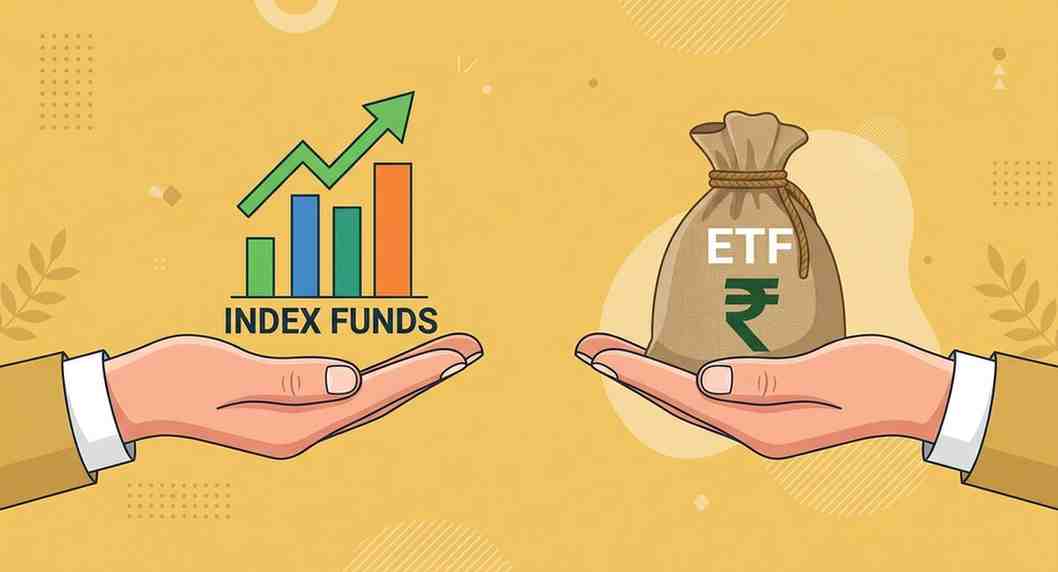
Index funds and exchange-traded funds are investment products designed to track the performance of a particular market index.
Instead of trying to select individual winning stocks, these funds aim to follow an index according to their investment objectives.
Index Funds
An index fund is a mutual fund that aims to replicate the performance of a particular index.
For example, a Nifty 50 index fund attempts to follow the performance of the Nifty 50.
Exchange-Traded Funds (ETFs)
An ETF is an investment fund that trades on a stock exchange like an individual share.
Many ETFs are designed to track specific stock market indices.
Index Funds vs ETFs
Feature | Index Funds | ETFs |
Trading | Generally bought or redeemed through the mutual fund | Traded on stock exchanges |
Pricing | Based on applicable NAV | Market price during trading hours |
Investment Approach | Usually passive | Many are passive |
Demat Account | Generally not required for direct mutual fund investment | Generally required |
Expense Ratio | Depends on the fund | Depends on the ETF |
Both options can provide diversified exposure to a group of companies, but investors should understand their costs, risks and tracking differences before investing.
Benefits of Following Stock Market Indices
Stock market indices offer several advantages for investors and financial market participants.
Some major benefits include:
Easy market tracking: Understand the general direction of the stock market.
Better comparison: Compare portfolio performance with relevant benchmarks.
Industry analysis: Follow specific sectors and business segments.
Investment research: Study market trends and historical performance.
Diversification opportunities: Access groups of stocks through index-based products.
Market understanding: Learn how economic developments affect equity markets.
Limitations of Stock Market Indices
Although stock market indices are useful, they do not provide a complete picture of every company or investment opportunity.
Investors should understand their limitations before relying on them.
1. They Do Not Represent Every Listed Company
A benchmark index tracks only selected companies. Thousands of other listed businesses may not be included.
2. Large Companies Can Have More Influence
In market-capitalisation-weighted indices, larger companies generally carry greater weight.
As a result, the movement of a few heavily weighted stocks can significantly influence the overall index.
3. An Index Cannot Guarantee Returns
A rising index does not mean every investor will make money. Actual investment returns depend on the investment, purchase price, expenses and holding period.
4. Sector Performance May Differ
A broad market index may rise even when certain industries are struggling.
This is why investors sometimes study sectoral indices separately.
5. Past Performance Does Not Guarantee Future Results
Historical index performance can help investors understand market behaviour, but it cannot reliably predict future returns.
How Beginners Can Use Stock Market Indices
For someone new to investing, stock market indices can be a helpful starting point.
Instead of immediately trying to understand every listed company, beginners can first learn how major indices work.
Here are some practical suggestions:
Start with benchmark indices: Understand Nifty 50 and BSE Sensex.
Learn about sectors: Follow banking, IT, healthcare and other sectoral indices.
Understand market movements: Observe how economic news affects index performance.
Compare investment returns: Learn how benchmarks are used to evaluate mutual funds.
Study index methodologies: Understand how companies are selected and weighted.
Learn about passive investing: Explore the basic differences between index funds and ETFs.
Beginners should avoid making investment decisions based only on daily index movements. A clear understanding of risk, financial goals and investment time horizons is equally important.
Important Terms Related to Stock Market Indices
Before following market indices regularly, it helps to understand some common financial terms.
Term | Meaning |
Benchmark | A reference point used to compare investment performance |
Market Capitalisation | Total market value of a company's outstanding shares |
Free Float | Shares considered available for public trading |
Index Constituents | Companies included in an index |
Index Weightage | The proportion of an index represented by a constituent |
Bull Market | A period of broadly rising market prices |
Bear Market | A period of broadly falling market prices |
ETF | Exchange-traded investment fund |
Index Fund | Mutual fund designed to track an index |
Volatility | The degree of price movement over time |
Conclusion
Stock market indices are an important part of the financial world. They help investors understand market performance, follow industry trends and compare investment returns without examining every listed company individually.
From India's Nifty 50 and BSE Sensex to international indices such as the S&P 500 and Nikkei 225, these market indicators provide valuable information about different economies and industries.
However, an index should not be treated as a guarantee of investment success. Its performance represents a selected group of stocks, not the entire market or every investor's financial experience.
For beginners, understanding stock market indices is a useful step towards becoming more financially aware. Learning how indices work, what influences their movements and how they are used in investing can make the stock market easier to understand.
The better you understand market indices, the easier it becomes to see the bigger picture behind daily stock market movements.