

Artificial intelligence is becoming an increasingly important part of modern finance. What began as experimentation with chatbots, automated reports, and predictive models is moving toward practical workflows that support everyday financial decisions.
Finance teams are expected to deliver accurate forecasts, faster reporting, stronger fraud controls, and reliable risk assessments. At the same time, they must manage growing volumes of financial data and respond to changing customer behavior.
AI can help organizations process information more quickly, identify unusual patterns, and reduce repetitive work. But its real value does not come from simply adopting a new technology. It comes from integrating AI into financial operations in a way that is measurable, secure, and accountable.
The next stage of AI in finance is not just about building models. It is about making those models useful in real-time forecasting, reporting automation, fraud prevention, and continuous model validation.
How AI Is Changing Everyday Finance Work

Traditional financial workflows often involve collecting data from multiple systems, cleaning spreadsheets, preparing reports, reviewing transactions, and manually checking results.
AI can support these activities by automating routine tasks and helping finance professionals focus on analysis rather than repetitive processing.
Finance activity | Traditional approach | AI-supported approach | Potential benefit |
|---|---|---|---|
Financial forecasting | Historical spreadsheets and manual assumptions | Predictive models using updated data | Faster forecast revisions |
Reporting | Manual data collection and formatting | Automated data summaries and report drafts | Reduced repetitive work |
Fraud monitoring | Fixed rules and manual investigation | Pattern recognition and risk scoring | Earlier suspicious activity alerts |
Model validation | Periodic manual checks | Automated performance and drift monitoring | More frequent model oversight |
AI does not eliminate the need for finance professionals. Instead, it can help them work with more information and identify issues that may otherwise take longer to discover.
1. Real-Time Financial Forecasting
Financial forecasting helps businesses estimate future revenue, expenses, cash flow, and financial performance. These forecasts guide budgeting, investment decisions, hiring, and business planning.
Traditional forecasting often relies on historical data and assumptions updated at fixed intervals. However, business conditions can change quickly. A sudden rise in operating costs, changes in customer demand, or delayed payments can make an earlier forecast less useful.
AI-supported forecasting can analyze multiple data sources and help update predictions as new information becomes available.
How AI Improves Forecasting
AI models can examine historical financial records alongside relevant business signals. Depending on the organization and available data, these may include sales activity, inventory levels, payment patterns, market conditions, and operating expenses.
Forecasting input | AI can analyze | Forecasting use | Important consideration |
|---|---|---|---|
Revenue history | Sales trends and seasonality | Estimate future revenue | Account for unusual events |
Expense records | Cost patterns and changes | Predict operating expenses | Verify data accuracy |
Cash flow | Receivables and payment timing | Identify potential cash gaps | Update payment assumptions |
Business activity | Orders, customer demand, inventory | Support planning decisions | Avoid relying on one signal |
For example, an AI forecasting system may identify that customer payments are arriving later than usual. It can help estimate the effect on future cash flow and alert the finance team to review the forecast.
The benefit is not necessarily a perfect prediction. It is the ability to identify changes earlier and make better-informed decisions.
Moving From Static Forecasts to Continuous Planning
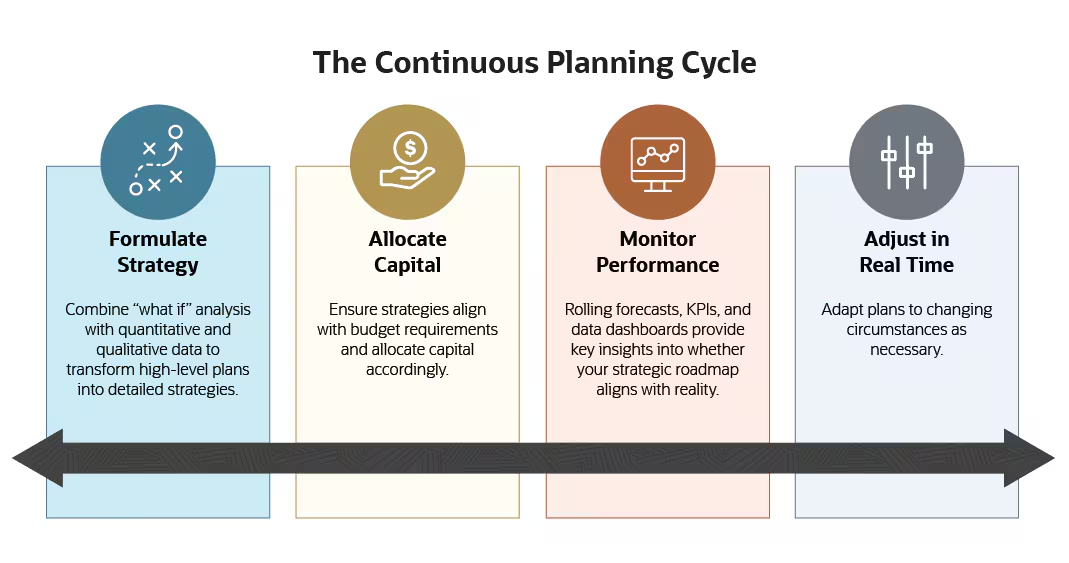
Instead of waiting until the end of a month or quarter, finance teams can use updated information to review forecasts more frequently.
This approach can support:
Rolling cash-flow forecasts
Revenue projections
Expense planning
Scenario analysis
Working-capital management
However, forecasts should always include assumptions and uncertainty. AI predictions are estimates, not guarantees of future financial performance.
2. Reporting Automation: Less Manual Work, More Analysis
Financial reporting is essential for understanding business performance. Yet preparing reports can involve repetitive activities such as consolidating data, checking figures, creating summaries, and formatting documents.
AI and automation can help streamline these tasks.
For example, an automated reporting workflow may collect approved data from accounting or enterprise systems, calculate selected metrics, and prepare a draft summary for review.
Reporting task | AI or automation support | Human responsibility | Expected result |
|---|---|---|---|
Data collection | Retrieve data from connected systems | Confirm source accuracy | Faster preparation |
Data reconciliation | Highlight differences | Investigate discrepancies | Better consistency |
Report drafting | Summarize financial trends | Review interpretation | Clearer reporting |
Variance analysis | Identify unusual changes | Explain business reasons | More useful insights |
Why Reporting Automation Matters
Automating repetitive reporting tasks can help finance teams spend less time preparing documents and more time understanding what the numbers mean.
A monthly report might show that operating expenses increased by 12%. AI can help identify which expense categories contributed most to the change and prepare a summary for further investigation.
But generated explanations should not be accepted without verification. A model may identify a correlation without understanding the actual business reason behind it.
Important pointer: Financial reports should be generated from verified data, use consistent definitions, and retain an audit trail of calculations and changes.
3. AI-Powered Fraud Prevention
Financial fraud is becoming more complex as digital payments, online banking, and instant transactions expand. Fraudsters may use stolen credentials, account takeover techniques, synthetic identities, or social engineering to deceive customers and financial institutions.
AI can support fraud prevention by analyzing transaction patterns and identifying activity that differs from expected behavior.
The OECD's 2026 report describes how AI-enabled systems can assess transactions and account activity in real time, helping financial institutions identify suspicious patterns and potential fraud.
How AI Detects Suspicious Transactions
AI-based fraud systems can consider multiple signals rather than relying on a single fixed rule.
Signal | What the system may detect | Possible risk |
|---|---|---|
Transaction amount | Unusual payment size | Possible unauthorized transaction |
Location or device | Unexpected access pattern | Account takeover |
Transaction frequency | Rapid repeated payments | Automated or suspicious activity |
Customer behavior | Activity unlike normal usage | Potential fraud or misuse |
For example, if a customer usually makes small payments from a familiar device but suddenly initiates several large transfers from a new location, an AI system may assign the transactions a higher risk score.
The institution can then apply an appropriate response, such as additional verification, a temporary hold, or review by a fraud analyst.
Real-Time Detection and Faster Response
Fraud prevention is especially important when transactions settle quickly. A suspicious payment identified after funds have moved may be more difficult to recover.
AI-powered systems can help assess transactions before or during processing, depending on the institution's infrastructure and payment workflow.
However, fraud detection must balance security with customer convenience. A system that flags too many legitimate transactions can create unnecessary friction and frustrate customers.
The goal is to identify genuinely suspicious activity while minimizing false alarms.
4. Model Validation: Making AI Reliable in Finance
AI models used in finance can influence important decisions. A forecasting model may affect a budget, while a fraud detection model may trigger a transaction review or block a payment.
Because these decisions can have financial and customer consequences, models must be tested and monitored throughout their lifecycle.
Model validation checks whether a model performs as expected, uses appropriate data, and remains reliable under changing conditions.
What Should Finance Teams Validate?
Validation area | What to check | Why it matters | Example |
|---|---|---|---|
Accuracy | Whether predictions are correct enough | Supports dependable decisions | Forecast error |
Data quality | Missing, outdated, or incorrect data | Prevents unreliable outputs | Incomplete transaction records |
Model drift | Changes in data or performance | Detects declining reliability | New fraud patterns |
Explainability | Reasons behind model outputs | Supports review and accountability | Transaction risk factors |
A model that performed well during initial testing may become less effective when customer behavior or market conditions change.
For example, fraudsters continually adapt their methods. A model trained on older transaction patterns may fail to recognize new techniques. Continuous monitoring helps teams identify when the model needs investigation, recalibration, or retraining.
Research on explainable financial AI highlights the importance of combining model performance with transparency, monitoring, and human oversight.
Human Oversight Is Still Essential
AI can provide a risk score or recommendation, but financial institutions should define when a human must review the result.
Human oversight is especially important when:
A transaction is blocked or delayed.
A financial forecast changes significantly.
A model produces an unexpected result.
A decision affects customer access to financial services.
A model's performance falls below an approved threshold.
A reliable AI workflow should make it possible to question, review, and override model outputs when appropriate.
5. Connecting AI With Existing Financial Systems
AI becomes more useful when it works with the systems finance teams already use.
Organizations may connect AI workflows with accounting software, payment platforms, customer relationship management systems, enterprise resource planning tools, and financial data warehouses.
The integration process should be planned carefully because financial data is sensitive and often distributed across multiple systems.
System | Data or function | AI-supported use | Control needed |
|---|---|---|---|
Accounting software | Revenue and expenses | Reporting and forecasting | Access permissions |
Payment systems | Transaction records | Fraud monitoring | Secure data transfer |
ERP platforms | Business operations | Cash-flow and cost analysis | Data validation |
CRM systems | Customer activity | Payment behavior analysis | Privacy protection |
Integrations should follow the principle of least privilege: AI tools should receive only the access required to perform their assigned tasks.
For AI agents that can take actions, organizations should also establish limits on what the system can approve, change, or execute without human confirmation.
6. Key Challenges of AI in Finance
Although AI offers practical benefits, financial organizations must address several risks before using it in important workflows.
Challenge | Potential impact | Recommended approach | Priority |
|---|---|---|---|
Poor data quality | Inaccurate forecasts or alerts | Establish data-quality checks | High |
Privacy concerns | Exposure of financial information | Use secure, approved systems | High |
Model bias | Unfair or inconsistent outcomes | Test across relevant groups | High |
Lack of explainability | Difficult decisions to review | Document model reasoning | High |
Over-automation | Errors may spread quickly | Set human approval points | High |
AI adoption should be guided by clear policies, documented responsibilities, and ongoing monitoring.
Financial institutions also need to consider vendor risk when using third-party AI services. They should understand how data is handled, what happens during system outages, and whether the provider supports appropriate audit and security requirements.
7. A Practical Roadmap for AI Adoption in Finance
Businesses do not need to automate every financial process at once. A gradual approach can help them test AI in lower-risk workflows before expanding into more sensitive activities.
Phase | Action | Example | Success measure |
|---|---|---|---|
1. Identify | Select a repetitive or costly task | Monthly report preparation | Clear business objective |
2. Pilot | Test AI with approved data | Drafting report summaries | Time saved |
3. Validate | Check quality and risks | Review calculations and outputs | Accuracy and compliance |
4. Integrate | Connect to existing workflows | Automated reporting pipeline | Reliable operation |
Start with a use case that has measurable results. For example, a finance team could compare the time required to prepare a report manually with the time required using an AI-assisted workflow.
If the pilot produces reliable results and meets security requirements, the organization can consider expanding its use.
The Future of AI in Finance
AI in finance is moving toward more connected and continuously monitored workflows. Forecasting, reporting, fraud detection, and model validation are increasingly being considered as parts of a broader financial operations strategy.
The strongest results will come from combining AI's speed and analytical capabilities with accurate data, sound governance, and experienced financial professionals.
AI can help finance teams identify patterns, prepare information faster, and respond to risks earlier. But trust remains the foundation of financial decision-making.
The future of finance will not depend only on how advanced an AI model becomes. It will depend on how responsibly organizations use it to support real-world decisions.