
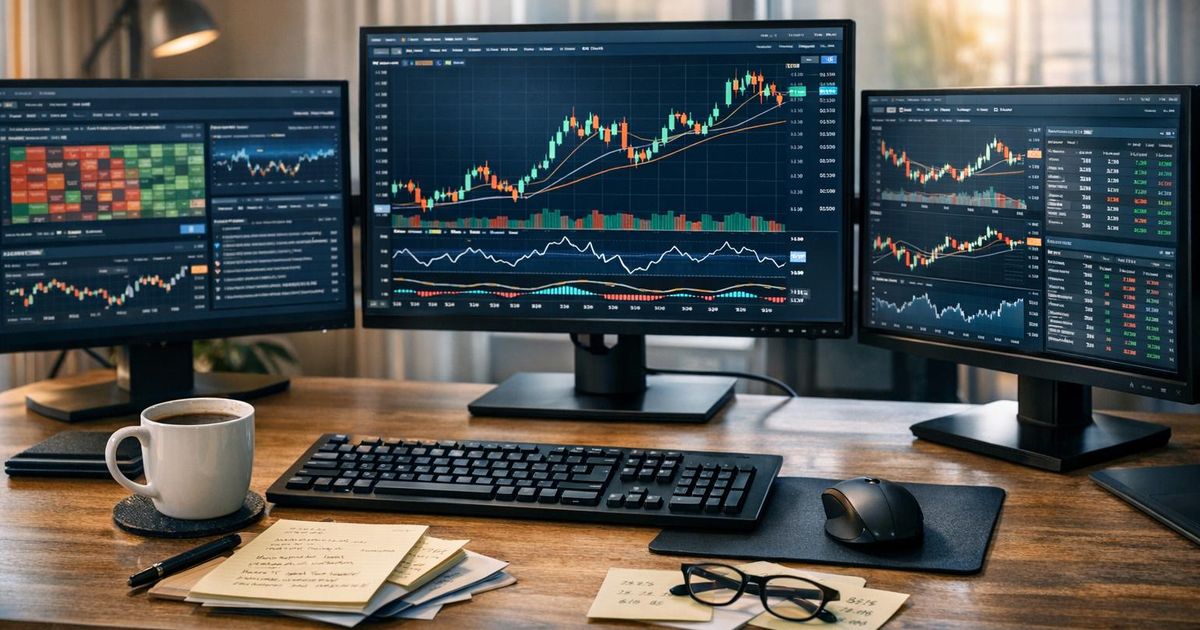
Stock trading has become an increasingly popular way for people to participate in financial markets and explore opportunities to grow their money. With online trading platforms, mobile applications and easy access to financial information, beginners can now enter the stock market without visiting a traditional brokerage office.
In 2026, stock trading continues to attract attention as investors explore opportunities in technology, banking, renewable energy, artificial intelligence and other growing industries. However, making money in the stock market requires more than simply buying shares when prices are rising. It involves understanding market movements, researching companies, managing risks and making informed decisions.
For beginners, knowing how stock trading works is the first step towards developing a sensible trading approach. Whether you are interested in intraday trading, swing trading or long-term investing, having a clear strategy can help you avoid common mistakes.
In this guide (opens in a new tab), we will explore stock trading basics, different trading strategies, how to start trading in 2026, important tools, risk management techniques and practical tips for beginners.
1. What Is Stock Trading?

Stock trading refers to buying and selling shares of publicly listed companies through a stock exchange. Traders generally aim to benefit from changes in share prices by purchasing stocks at one price and selling them at a higher price.
For example, suppose you purchase 10 shares of a company at Rs. 200 each. Your total investment is Rs. 2,000.
If the share price increases to Rs. 230 and you sell all 10 shares, your selling value becomes Rs. 2,300. Your gross profit would be Rs. 300 before brokerage, taxes and other applicable charges.
However, stock prices can also fall. If the share price drops to Rs. 180, selling your shares would result in a loss of Rs. 200.
In India, stock trading primarily takes place through two major exchanges:
National Stock Exchange (NSE): One of India's leading stock exchanges, known for its electronic trading platform and popular Nifty 50 index.
Bombay Stock Exchange (BSE): One of Asia's oldest stock exchanges, home to the widely followed Sensex index.
Both exchanges provide platforms for investors and traders to buy and sell listed securities.
2. How Does Stock Trading Work?
Stock trading works through a system that connects buyers and sellers through stock exchanges and registered brokers.
When someone places an order to purchase a share, the trading platform attempts to match it with a suitable selling order.
Here is how the process generally works:
Open a trading account: Choose a SEBI-registered stockbroker and complete the required verification process.
Add funds: Transfer money from your bank account to your trading account.
Research stocks: Study company performance, financial information (opens in a new tab) and market trends.
Place an order: Select a stock, enter the quantity and choose an appropriate order type.
Order execution: The exchange matches compatible buy and sell orders.
Monitor your position: Track price movements and manage your trading decisions.
Sell your shares: Close your position when your trading plan indicates it is appropriate.
A demat account holds shares electronically, while a trading account allows you to place buy and sell orders.
3. Different Types of Stock Trading in 2026
Not every trader follows the same approach. Some prefer buying and selling shares within a single trading session, while others hold positions for several days, weeks or months.
Here are some common types of stock trading.
A. Intraday Trading
Intraday trading involves purchasing and selling stocks within the same trading day. Traders attempt to benefit from short-term price movements without carrying their positions overnight.
Key features:
Positions are generally closed before the market session ends.
Traders closely monitor price charts and market activity.
Technical indicators are frequently used.
Market volatility can create both opportunities and significant losses.
Intraday trading requires experience, discipline and regular market monitoring. It may not be suitable for beginners who are unfamiliar with price fluctuations.
B. Swing Trading
Swing trading focuses on capturing price movements over several days or weeks.
Instead of making multiple trades in one day, swing traders identify potential price trends and hold positions until their trading objectives or risk limits are reached.
Key features:
Holding periods can range from days to weeks.
Technical analysis helps identify possible entry and exit points.
Traders often look for support, resistance and market trends.
It requires less continuous monitoring than intraday trading.
C. Positional Trading
Positional trading involves holding stocks for several weeks or months to benefit from larger market movements.
Traders often combine company research with technical analysis to identify potential opportunities.
This approach requires patience because market prices may experience temporary fluctuations before moving in the expected direction.
D. Scalping
Scalping is a short-term trading approach where traders attempt to capture small price movements through multiple trades.
It requires quick decision-making, careful execution and close attention to transaction costs.
Frequent trading can increase costs and magnify losses, making this approach particularly challenging for beginners.
E. Long-Term Investing
Long-term investing focuses on purchasing shares of companies with the intention of holding them for several years.
Instead of focusing on daily price movements, investors generally examine business performance, financial strength, management quality and future growth potential.
Although commonly discussed alongside stock trading, long-term investing is a different approach with a longer time horizon.
4. How to Start Stock Trading in 2026: Step-by-Step Guide

Starting stock trading may seem complicated initially, but understanding the basic requirements can make the process easier.
Follow these steps before placing your first trade.
Step 1: Understand Stock Market Basics
Before investing money, learn how stock exchanges operate and understand basic concepts such as shares, market orders, limit orders, volume, market capitalisation and price movements.
A strong understanding of these terms can help you make more informed decisions.
Step 2: Open a Demat and Trading Account
To trade in Indian stock markets, you generally need:
A PAN card.
A valid bank account.
A demat account.
A trading account.
Completed KYC verification.
Choose a SEBI-registered stockbroker and carefully review its brokerage fees, platform features and other applicable charges.
Step 3: Choose a Reliable Trading Platform
A trading platform allows you to monitor market prices, study charts and execute orders.
Before choosing a platform, compare:
Brokerage and transaction charges.
Ease of use.
Charting and research tools.
Order execution features.
Customer support.
Account security.
Step 4: Start With a Small Amount
Avoid committing a large amount of money to your first trade.
Begin with an amount you can afford to lose without affecting your essential expenses or financial responsibilities.
The initial objective should be learning how trading works rather than trying to generate large profits immediately.
Step 5: Learn Technical and Fundamental Analysis
Technical analysis examines historical price movements, trading volume and chart patterns to identify possible trading opportunities.
Fundamental analysis evaluates a company's financial health, business model, earnings and growth prospects.
Understanding both approaches can help traders develop a more balanced research process.
Step 6: Create a Trading Plan
A trading plan should define:
Which stocks you want to study.
Your preferred trading approach.
Entry and exit conditions.
Maximum acceptable loss.
Position size.
Trading objectives.
Having a written plan can reduce impulsive decisions during volatile market conditions.
5. Best Stock Trading Strategies for Beginners
A trading strategy provides a framework for making decisions instead of reacting emotionally to every market movement.
Here are some commonly used strategies beginners can study.
1. Trend Following Strategy
Trend following involves identifying the general direction of a stock's price movement.
Traders may look for stocks showing consistent upward or downward trends before considering a trade.
Moving averages are commonly used to understand price trends.
2. Support and Resistance Strategy
Support refers to a price area where buying interest may increase, while resistance is an area where selling pressure may become stronger.
Traders use these levels to identify potential entry and exit opportunities.
However, support and resistance levels are not guaranteed to hold.
3. Moving Average Strategy
Moving averages calculate the average price of a stock over a selected period.
Common examples include:
20-day moving average.
50-day moving average.
100-day moving average.
200-day moving average.
Traders use these indicators to study market direction and possible changes in momentum.
4. Breakout Trading Strategy
Breakout trading involves identifying when a stock moves beyond an established support or resistance level.
Traders often examine trading volume to evaluate whether a breakout has meaningful market participation.
False breakouts are possible, so risk management remains important.
5. Volume-Based Trading
Trading volume represents the number of shares exchanged during a particular period.
A sudden increase in volume may indicate stronger market activity. Traders combine volume information with price movements to study market behaviour.
No strategy works in every market condition. Beginners should practise and evaluate strategies before using real money.
6. Best Technical Indicators for Stock Trading
Technical indicators help traders examine price movements, momentum and market trends.
Here are some popular indicators used in stock market analysis.
Indicator | Purpose |
|---|---|
RSI | Measures the speed and strength of price movements |
MACD | Helps identify momentum and potential trend changes |
Moving Average | Studies overall price direction |
Bollinger Bands | Measures price volatility |
VWAP | Tracks the average traded price weighted by volume |
Stochastic Oscillator | Compares closing prices with a recent price range |
Relative Strength Index (RSI): RSI is a momentum indicator generally measured on a scale from 0 to 100. Readings above 70 are traditionally considered overbought, while readings below 30 are considered oversold. These levels do not automatically indicate that a stock will reverse.
Using multiple indicators together may provide additional context, but too many indicators can make trading decisions unnecessarily complicated.
7. Fundamental Analysis vs Technical Analysis
Both fundamental and technical analysis are important approaches to studying the stock market. However, they focus on different aspects.
Factor | Fundamental Analysis | Technical Analysis |
|---|---|---|
Main focus | Company performance | Price movements |
Data used | Revenue, profit, debt and cash flow | Charts, volume and indicators |
Purpose | Evaluate business quality and value | Identify potential trading opportunities |
Common users | Long-term investors | Short-term and medium-term traders |
Time horizon | Usually longer term | Often short or medium term |
For example, someone researching a banking company may examine its profitability, loan quality and financial position through fundamental analysis.
A technical trader studying the same stock may examine its price chart, trading volume and moving averages.
Both approaches can complement each other, depending on the trading objective.
8. How to Manage Risk in Stock Trading
Risk management is one of the most important parts of stock trading. Even experienced traders can make incorrect predictions, and unexpected market movements can create losses.
Here are some practical ways to manage trading risks.
1. Use Stop-Loss Orders
A stop-loss order helps manage potential losses by setting a predefined exit level. However, execution price may differ from the trigger price during sudden market movements or gaps.
2. Avoid Investing All Your Money in One Stock
Diversifying investments across different companies and sectors can help reduce exposure to a single company's performance.
3. Avoid Excessive Leverage
Trading with borrowed money or high leverage can increase both potential gains and potential losses. Beginners should understand the risks before considering leveraged products.
4. Set a Risk Limit
Decide how much you are willing to lose on an individual trade and over a particular period.
5. Maintain a Trading Journal
Record your trades, entry prices, exit prices, reasons for entering and lessons learned. Reviewing this information can help identify repeated mistakes.
6. Avoid Emotional Trading
Fear, greed and the desire to recover previous losses can lead to poor decisions. Follow your trading plan instead of reacting to every market movement.
9. Common Stock Trading Mistakes Beginners Should Avoid
Many beginners enter the stock market with high expectations but overlook the importance of research and discipline.
Here are some common mistakes to avoid.
Following random stock tips: Making decisions based on unverified social media messages can expose you to unnecessary risks.
Trading without a strategy: Entering the market without clear objectives can result in inconsistent decisions.
Ignoring brokerage charges: Frequent trading expenses can reduce overall returns.
Overtrading: Making too many trades can increase costs and emotional pressure.
Chasing rising stocks: Buying shares simply because their prices are increasing may lead to poor entry decisions.
Ignoring market news: Company announcements and economic developments can influence stock prices.
Expecting guaranteed profits: Stock market returns are uncertain, and losses are always possible.
Avoiding these mistakes can help beginners develop a more disciplined approach to the market.
10. How Technology and AI Are Changing Stock Trading in 2026
Technology is changing how traders research stocks, analyse market information and execute orders.
Artificial intelligence, automation and advanced data analytics are becoming increasingly relevant to modern financial markets.
Some important developments include:
AI-Powered Market Analysis
AI tools can process large amounts of financial information, identify patterns and help traders organise market research.
Algorithmic Trading
Algorithmic trading uses computer programs to execute orders according to predefined rules and conditions.
Automated Alerts
Trading platforms can notify users about price changes, technical indicators and selected market events.
Advanced Charting Tools
Modern charting platforms provide technical indicators, historical price information and custom analysis features.
Real-Time Market Data
Access to market information allows traders to monitor changing prices and trading activity more efficiently.
However, AI tools cannot predict every market movement or guarantee profits. Traders should independently verify information and understand the risks before acting on automated signals.
11. Important Stock Trading Terms Every Beginner Should Know
Before entering the stock market, it is useful to understand some commonly used trading terms.
Trading Term | Meaning |
|---|---|
Bull Market | A market experiencing a sustained upward trend |
Bear Market | A market experiencing a sustained downward trend |
IPO | Initial Public Offering, when a company offers shares to the public for the first time |
Market Capitalisation | Total market value of a company's outstanding shares |
Liquidity | How easily an asset can be bought or sold |
Volatility | The degree of price fluctuations |
Portfolio | Collection of investments held by an investor |
Brokerage | Fee charged by a broker for trading services |
Dividend | A distribution of company profits to eligible shareholders |
Stop-Loss | An order or instruction designed to limit potential losses |
Understanding these terms makes it easier to follow financial news, research companies and use trading platforms.
12. Is Stock Trading Profitable for Beginners in 2026?
Stock trading can offer opportunities to generate returns, but profitability is never guaranteed.
A beginner's results depend on several factors, including market conditions, trading knowledge, investment capital, transaction costs, risk management and decision-making.
Some traders may generate profits during favourable market conditions, while others may experience repeated losses.
It is important to understand that short-term trading involves considerable risk. In particular, intraday and derivatives trading can be challenging for inexperienced participants.
Beginners should focus on:
Learning market fundamentals.
Practising with virtual trading tools.
Starting with manageable amounts.
Avoiding borrowed money.
Studying company performance.
Maintaining realistic expectations.
A consistent learning process and disciplined financial decisions are more valuable than chasing quick profits.
Conclusion
Stock trading in 2026 offers access to a wide range of financial opportunities, but successful trading requires knowledge, preparation and discipline. Understanding different trading styles, studying company performance and learning technical analysis can help beginners make more informed decisions.
From intraday and swing trading to positional trading, every approach has its own advantages and risks. There is no guaranteed strategy that works in every market condition.
For beginners, the best starting point is to build a strong foundation, practise trading strategies, manage risk carefully and avoid unrealistic profit expectations. With continuous learning and responsible financial decisions, traders can develop a more structured approach to participating in the stock market.
Frequently Asked Questions
1. What is stock trading?
Stock trading involves buying and selling company shares to benefit from price movements.
2. How can beginners start stock trading?
Open a demat and trading account, learn market basics and start with a small amount.
3. Is stock trading profitable?
Stock trading can generate profits, but returns are not guaranteed and losses are possible.
4. Which trading is best for beginners?
Swing and positional trading may give beginners more time to analyse the market.
5. Is stock trading risky?
Yes, stock prices fluctuate, and traders can lose some or all of their invested money.