

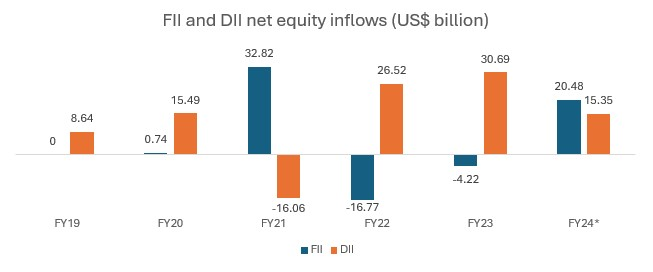
The Indian stock market has traditionally been influenced by foreign institutional investors (FIIs), whose large investments and withdrawals can significantly affect market movements. However, the growing participation of domestic retail investors, mutual funds, and domestic institutional investors (DIIs) is changing the investment landscape.
Today, millions of Indian households participate in equity markets through direct stock investments and Systematic Investment Plans (SIPs). Their regular contributions provide an important source of domestic capital, even when foreign investors reduce their exposure to Indian equities.
This raises an important question: Can domestic investors support the Indian stock market when foreign investors are selling?
The answer depends on several factors, including domestic investment flows, foreign capital movements, corporate earnings growth, market valuations, and overall economic conditions.
1. Understanding Domestic Retail Investment in India
Domestic retail investment refers to money invested by individual Indian investors in financial markets. Investors participate directly by purchasing shares or indirectly through mutual funds, SIPs, and other investment products.
One of the biggest contributors to domestic market participation is the growing popularity of SIPs.
Why Are SIP Investments Growing?
SIPs allow investors to invest a fixed amount regularly in mutual funds instead of investing a large amount at once. This approach encourages financial discipline and makes equity investing accessible to people with different income levels.
According to AMFI's October 2026 monthly note, monthly SIP contributions reached approximately ₹32,160 crore, while contributing SIP accounts stood at around 10 crore.
This demonstrates how regular household savings are becoming an important part of India's investment ecosystem.
Major Sources of Domestic Investment
Investment Type | Meaning | Market Impact | Investor Objective |
|---|---|---|---|
SIP Investments | Regular mutual fund contributions | Provides consistent capital | Long-term wealth creation |
Direct Equity | Purchasing company shares | Adds retail market participation | Capital appreciation |
Equity Mutual Funds | Investing through pooled funds | Supports institutional buying | Diversification |
Exchange-Traded Funds | Investing through market-traded funds | Adds market liquidity | Index-based exposure |
Domestic participation is not limited to experienced investors. Digital investment platforms, improved financial awareness, and easier access to demat accounts have also encouraged more individuals to participate in financial markets.
2. Foreign Institutional Investors and Their Market Influence

Foreign Institutional Investors, commonly referred to as FIIs, are overseas institutions that invest in financial markets in countries such as India.
These investors include international mutual funds, pension funds, insurance companies, and other large financial institutions. Their investments are generally influenced by global economic conditions, interest rates, currency movements, and expected returns.
Foreign investment can bring significant capital into Indian markets. However, large withdrawals can also create selling pressure.
Why Do Foreign Investors Buy or Sell Indian Stocks?
Foreign investors evaluate India against other investment destinations. If they expect stronger returns in another country, they may reduce their Indian equity exposure.
Some important factors influencing foreign investment decisions include:
US Federal Reserve interest rates: Higher interest rates in developed economies can make international investors reconsider emerging-market investments.
Currency movements: Changes in the Indian rupee against the US dollar can influence foreign investment returns.
Corporate earnings: Strong company profits can attract foreign capital.
Global economic uncertainty: Geopolitical tensions and economic slowdown concerns can encourage investors to move toward safer assets.
Market valuations: Expensive stock valuations can make investors more cautious.
Domestic vs Foreign Investors: Key Differences
Factor | Domestic Investors | Foreign Investors | Market Influence |
|---|---|---|---|
Capital Source | Indian household savings | International capital | Determines investment flows |
Investment Drivers | SIPs and domestic growth | Global returns and economic conditions | Influences market sentiment |
Investment Horizon | Often long-term through SIPs | Varies by investment strategy | Affects market stability |
Major Risks | Domestic inflation and market volatility | Currency and global economic risks | Can influence buying and selling |
Foreign investors remain important because their large transactions can influence market liquidity, valuations, and short-term price movements.
3. How Domestic Retail Flows Counterbalance Foreign Capital Outflows
One of the most interesting developments in India's financial markets is the increasing ability of domestic institutions to absorb foreign selling pressure.
When foreign investors sell Indian shares, domestic institutions may purchase those shares using money received through mutual funds, insurance products, and other domestic investment channels.
This does not mean domestic investors always purchase everything foreign investors sell. However, stronger domestic participation can help reduce the impact of foreign withdrawals.
The Growing Role of Domestic Institutional Investors
Domestic Institutional Investors include mutual funds, insurance companies, pension funds, and other Indian financial institutions.
Their investments are often supported by regular domestic savings and long-term investment commitments.
The Reserve Bank of India's 2025–26 financial sector reporting highlighted the growing importance of domestic investment participation and the continued expansion of the mutual fund industry.
This shift is important because Indian markets are becoming less dependent on a single source of capital.
Important factors supporting domestic investment flows:
Regular SIP contributions.
Increasing mutual fund participation.
Greater financial awareness.
Expansion of digital investment platforms.
Long-term household wealth creation goals.
However, domestic flows cannot completely protect the market from corrections caused by weak earnings, expensive valuations, or broader economic uncertainty.
4. Corporate Earnings Growth: The Real Foundation of Market Rallies
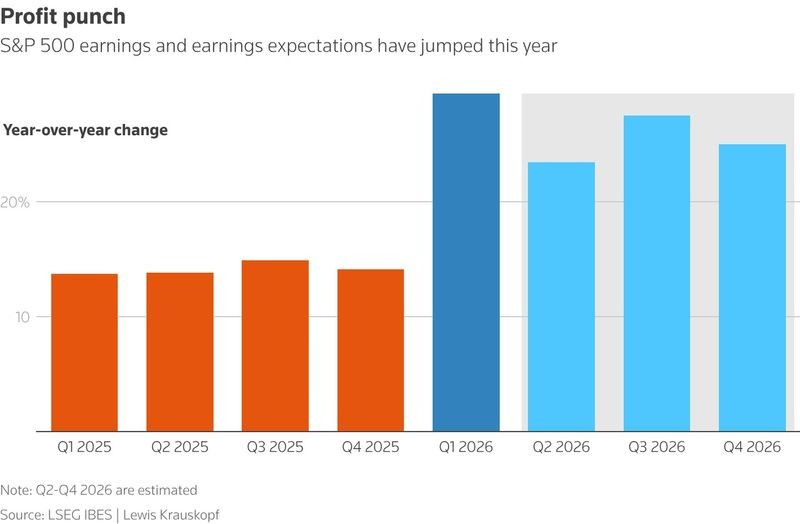
Investment flows can influence stock prices in the short term, but corporate earnings play a major role in determining long-term market performance.
Corporate earnings represent the profits companies generate through their business operations. When companies report improving revenue, stronger profit margins, and better earnings growth, investors may become more confident about their future prospects.
Why Earnings Matter More Than Investment Flows
Imagine a company reporting consistent revenue growth, increasing profits, and expanding business operations. Investors may be willing to pay a higher price for its shares because they expect future earnings to improve.
On the other hand, if a company's stock price rises despite declining profits, its valuation may become difficult to justify.
The following factors are particularly important:
Revenue growth: Indicates whether a company's products or services are generating higher sales.
Profit margins: Show how efficiently a business converts revenue into profits.
Earnings per share (EPS): Helps investors understand the profit attributable to each outstanding share.
Debt levels: High borrowing costs can affect profitability.
Future guidance: Management expectations can influence investor confidence.
Key Financial Indicators to Monitor
Indicator | What It Measures | Positive Signal | Market Importance |
|---|---|---|---|
Revenue Growth | Increase in company sales | Consistent expansion | Indicates business demand |
Net Profit | Earnings after expenses | Improving profitability | Supports valuations |
EPS | Earnings per share | Rising EPS | Helps assess growth |
P/E Ratio | Price relative to earnings | Reasonable valuation | Indicates stock pricing |
A healthy stock market rally is generally supported by sustainable earnings growth rather than investment inflows alone.
5. What Drives a Stock Market Rally?
A stock market rally occurs when stock prices rise over a period of time. However, rallies do not happen because of one single factor.
Domestic buying, foreign investment, improving corporate performance, positive economic indicators, and investor confidence can work together to support rising markets.
Four Major Drivers of Indian Market Rallies
1. Strong Domestic Investment
Regular SIP contributions and domestic institutional buying can provide consistent demand for equities. This can help support market prices during periods of foreign selling.
2. Positive Foreign Capital Flows
When foreign investors increase their Indian equity exposure, their large investments can improve market sentiment and support share prices.
3. Better Corporate Earnings
Companies reporting higher profits and stronger future growth expectations can attract long-term investors.
4. Economic Growth and Policy Stability
Infrastructure development, consumption, industrial expansion, and stable economic policies can improve business confidence and investment expectations.
How Different Factors Affect Market Performance
Market Factor | Positive Development | Possible Negative Impact | Overall Effect |
|---|---|---|---|
Retail Flows | Increasing SIP contributions | Rising redemptions | Influences domestic demand |
Foreign Investment | Higher FPI inflows | Large-scale withdrawals | Affects liquidity |
Corporate Earnings | Strong profit growth | Earnings slowdown | Influences valuations |
Economic Conditions | Higher consumption and growth | Inflation and uncertainty | Changes investor confidence |
These factors should be considered together rather than evaluated independently.
6. Risks Investors Should Watch
Although increasing domestic participation is encouraging, investors should not assume that regular SIP inflows or foreign capital movements will always support rising markets.
Stock markets remain sensitive to economic changes, unexpected events, and company-specific risks.
Major Risks in the Indian Stock Market
Foreign Investor Selling: Large-scale foreign withdrawals can create short-term volatility, particularly in stocks with significant foreign ownership.
Overvalued Stocks: When stock prices rise much faster than company earnings, valuations may become expensive and increase correction risks.
Weak Corporate Earnings: Disappointing quarterly results can reduce investor confidence and affect stock prices.
Inflation and Interest Rates: Higher inflation and borrowing costs can affect consumer spending, corporate profitability, and investment decisions.
Global Uncertainty: International conflicts, changes in trade policies, and financial market instability can influence foreign capital flows.
Investors should focus on business fundamentals, diversification, risk management, and their individual financial goals rather than reacting to every market movement.
7. What Does the Future Hold for Indian Equity Markets?
India's investment ecosystem is evolving as more households participate in financial markets through mutual funds, SIPs, and direct equity investments.
The growing contribution of domestic investors could make the Indian market more resilient to temporary foreign capital withdrawals. At the same time, international investors will continue to play an important role in determining liquidity, valuations, and market sentiment.
Corporate earnings will remain a critical factor in deciding whether market rallies can continue over the long term.
Investors should also monitor developments in banking, technology, manufacturing, infrastructure, consumption, and other sectors that contribute to India's economic growth.
The key takeaway is that domestic capital can support the market, foreign capital can influence its direction, and corporate earnings can determine the sustainability of its growth.